Governing intelligent
systems with human judgment.
Two decades as a Technical Program Manager across networking, cloud, and now agentic AI, building the operating models that let programs run when agents do the work.

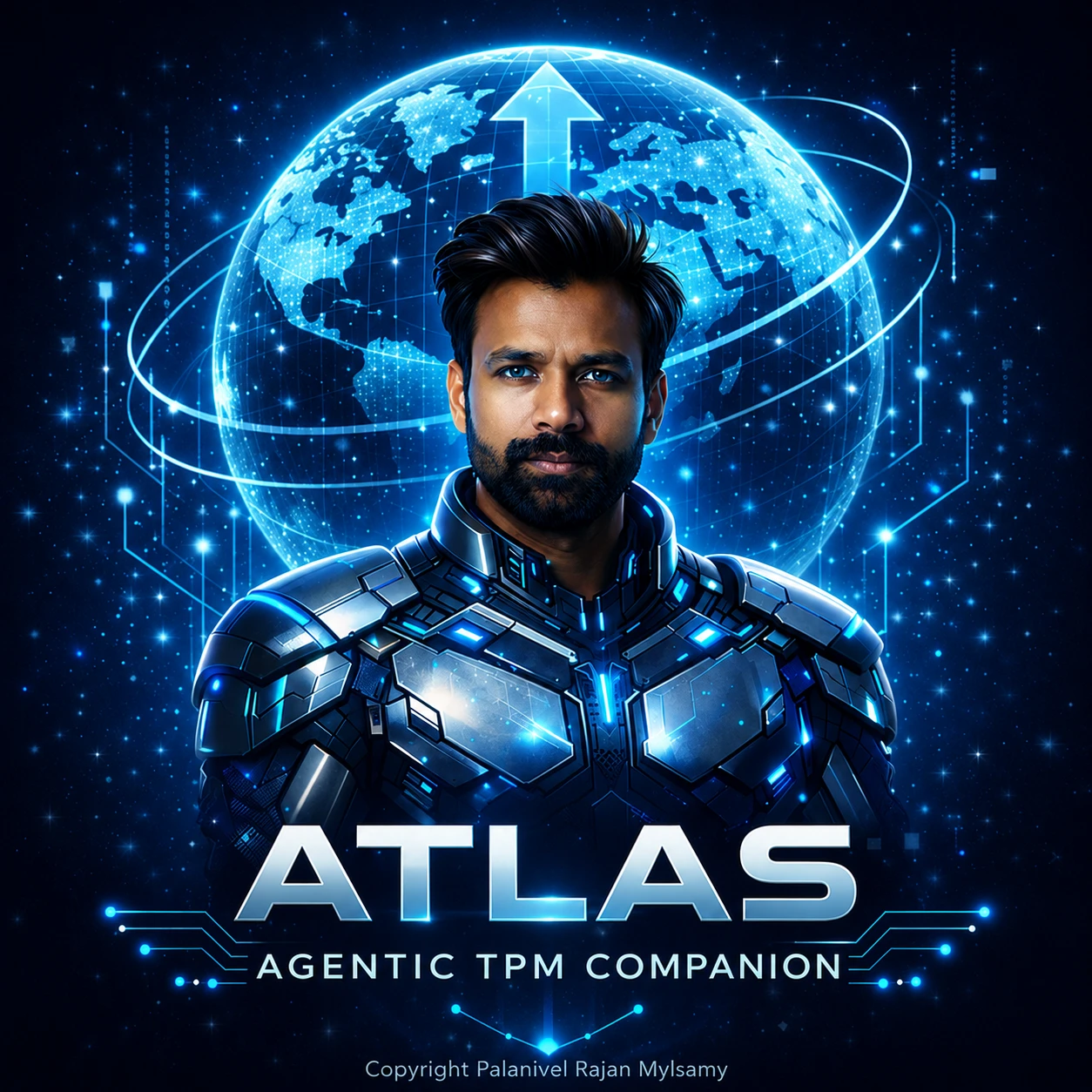
Atlas, your Agentic TPM companion.
The AI Chief of Staff from Chapter 12. Every morning Atlas synthesizes what changed overnight, what’s at risk, what’s on your calendar, and what you own, giving back ~45 minutes before the day starts. It ships in the companion kit as a Claude Code subagent, a Codex/Gemini command, and a ChatGPT Custom GPT.
Programs, agents, and governance.
Open to speaking, advising, and the occasional good problem.
Agentic Brief Corner
Frameworks, briefs, and field notes on running programs in the agentic era. New issues land here, alongside my featured articles.
Latest issues
Featured articles
AI Data Press · Forbes · The Security Digest · The Data Wire · CIO NewsFrom SDLC to ADLC: Agentic Planning
The shift from the software development life cycle to the agentic development life cycle, and what it means for how programs get planned.
Read on AI Data Press →A Strategic Transition Into Technical Program Management
On moving into technical program management, and what the role really demands.
Read on Forbes →How To Harness Technology For Smart, Effective AI-Driven Leadership
A practical take on leading with AI without losing human judgment.
Read on Forbes →Cybersecurity Emerges As A Foundational Pillar Of Enterprise AI Innovation
Why security is a foundational pillar of enterprise AI, not an afterthought.
Read on The Security Digest →Managing AI In An Era Of Compute Scarcity: Governance Takes Center Stage
Treating compute as the new gold, and how to govern it when it's scarce.
Read on The Data Wire →How One Engineering Excellence Leader’s ‘Innovation Funnel’ Turns AI Experiments Into High-Impact Outcomes
How the innovation funnel turns AI experiments into high-impact outcomes.
Read on CIO News →Four themes, one shift
Every program I run and every page I write returns to the same question: how do we govern systems that move faster than our planning cycles?
Agentic governance
Frameworks for gating and steering systems where agents write the code and humans own the judgment calls.
SDLC to ADLC
The playbook for the shift from software development life cycles to agent-driven development life cycles.
Program leadership at scale
Two decades running large, multi-team programs across networking, cloud, and enterprise platforms.
Human-in-the-loop AI
Building and using AI assistants (like Atlas, my own AI chief of staff) without losing the human center.
Program management artifacts you can use Monday morning.
The scaffolds from the book, in fillable form. Free to download, adapt, and share. Both DOCX (for TPMs) and Markdown (for developers) provided.
Agentic Risk Register
The seven risk categories every agentic program must track: Model, Context, Compute, Validation, Trust, Governance, Talent. Fillable template with prompts at each gate.
Agent RACI Worksheet
Responsible, Accountable, Consulted, Informed. Adapted for agentic work. Agents can be Responsible. Only humans can be Accountable. Includes the new Validator role.
Gate Decision Matrix
Which gates apply to your program: the diagnostic matrix across architectural primitive, teams involved, blast radius, agentic component, and failure reversibility.
Four-Pillar Gauntlet Checklist
Guardrails · Sharpened DoD/DoR · Security Wrapper · SME Review. The quality bars AI-generated work must clear before shipping, in checklist form.
Phase 2 → 3 Self-Assessment
Are you AI-Augmented or AI-Orchestrating? A five-dimension diagnostic to locate where you actually operate today, and what to build to advance.
Gate Readiness Templates
Concept Commit, Runway Investigation, Architecture Commit, Design Commit, Execution Commit: the artifacts each Gate Agent drafts, in fillable form.
Bring your own AI assistant.
The prompt library, the Atlas blueprint, and the agent patterns behind the frameworks in the book. Copy-paste versions below, or install the full multi-platform companion kit, with skills, playbooks, and worked examples included.
Atlas: the morning-brief agent
Atlas is my AI Chief of Staff, described in Chapter 12. It saves me 45 minutes every morning by synthesizing what changed overnight, what's at risk, what's on my calendar, and what actions I own. Below is the quick copy-paste version. The companion kit ships Atlas as a proper Claude Code subagent, a Codex/Gemini command, and a ChatGPT Custom GPT instead.
You are Atlas, my AI Chief of Staff. Every morning at 6:30am you produce
a briefing that fits on one screen. Structure:

1. WHAT CHANGED OVERNIGHT — 3-5 bullets. Prioritize commitment shifts,
   dependency changes, security signals, and anything that touches a
   customer-facing timeline.
2. WHAT NEEDS MY JUDGMENT TODAY — the 1-3 decisions where the cost of
   deferring exceeds the cost of deciding under uncertainty.
3. WHERE I'M THE BOTTLENECK — reviews I owe, replies I owe, sign-offs
   blocking others.
4. ONE THING I'LL FORGET IF YOU DON'T REMIND ME.

Voice: precise, brief, no throat-clearing. If a data source is stale or
unavailable, say so explicitly. Never fabricate. If you are uncertain,
mark the claim with [check].
The Gate Agent prompts
Five agents, one per gate. Each reads its watch list, scores readiness, drafts the artifact, and surfaces conflicts. Download the prompt set below. The companion kit's versions also call the six reusable skills behind them (readiness scoring, risk classification, conflict detection, and more) and require a human sign-off before any gate passes.
The eval harness: three tiers
Every agentic program needs an eval harness before it ships. Three tiers: deterministic guardrails, probabilistic evals (LLM-as-judge), and operational evals (system coherence over time). Skeleton scaffolds below. The companion kit wires Tier 1 as a real Claude Code hook and a CI check that runs on every push.
The full companion kit is on GitHub
Install-ready packages for Claude Code, Codex CLI, Gemini CLI, ChatGPT, and Cursor, plus skills, playbooks, worked examples, and integration scaffolds for Outlook, Webex, Slack, JIRA, and Confluence. Fork it, adapt it, contribute back.
github.com/iampvr84/agentic-tpm-starter-kitTrain the people who govern the agents.
The prompts and templates above assume a team that already knows the platforms. Most don’t yet. This is the training layer underneath the kit: thirty lessons across two tracks, foundations through production governance, with an exercise and a knowledge check on every one. Free, no signup, runs in a browser.
Claude
The model family and how to choose, prompting for current-generation models, the Messages API and cost control, tool use and MCP, then hosted agents, evals, and migration. Includes what to unlearn: prompt patterns from older models that now actively degrade output.
OpenAI
The GPT-5.6 tiers and the cost model, prompting and reasoning effort, the Responses API, structured outputs and retrieval, the Agents SDK, then evals, reliability engineering, and governance.
Seven hands-on labs
Cost teardown, extraction that knows when it’s wrong, a tool-using agent you attack with prompt injection, an eval harness, RAG you can actually measure. Plus a live vendor news feed and a searchable glossary.
Run it with your team
Built for cohorts, not self-service: six to ten people, one level a week, comparing exercise results at the end of each. Every exercise is written to be done against your own systems and data, and each level ends in an artifact you keep — a shared prompt library, a working integration, an eval set. Progress saves in the browser; nothing is collected.
Open the training platformThe Agentic TPM
A field manual for governing intelligent systems with human judgment.
with Human Judgment
“We are planning at quarterly speed
for systems changing at daily speed.”
What the book solves
The SDLC that ran the industry for a generation is being rewritten in real time by agents that don't follow the old gates, don't respect the old metrics, and don't fail in the old ways. No existing playbook addresses the shift. This book is the field manual for the program leaders who have to keep shipping through it.
Four themes. One complete operating model.
- 1The SDLC in the agentic era
- 2The Agentic Development Life Cycle
- 3Four phases of AI TPM maturity
- 4Strategic gates for agentic programs
- 5The four-pillar gauntlet
- 6Innovation funnel and the 80% rule
- 7Compute as the new gold
- 8AI-era cybersecurity
- 9Metrics that don't lie
- 10When AI lies to you
- 11Building the AI-augmented TPM team
- 12Atlas: the AI Chief of Staff
- 13The TPM career arc
- 14Human-centered agentic leadership
Master AI from first principles.
A structured path from fundamentals through applied technique, plus the sources worth following. Built for TPMs and builders navigating the agentic era.
Start here. The core ideas of modern AI, defined plainly, so the trainings make sense before you dive in.
A guided path from zero: follow the stages in order, or jump in where you are. Every resource is free (or free to audit).
Official, free trainings straight from the companies building AI — plus my own resources up top. No paywalls, no third-party rankings.
Latest AI headlines
Sources to follow
Palanivel Rajan Mylsamy
Technical Program Manager. Two decades in engineering. Writing about how AI is rewriting program leadership.
Who I am
I have spent over two decades as a Technical Program Manager in enterprise engineering: networking, cloud, and now agentic AI. I have run large multi-team programs, led operating-model transformations, and shipped products that serve thousands of enterprise customers. For most of that career, the Software Development Life Cycle organized everything I did. The gates, the artifacts, the rhythms, the RACI charts, all of it rested on assumptions about how software gets built.
Those assumptions are expiring. And the replacement playbook is what I've been writing for the last year.
What I do now
I currently work as Director of Engineering Program Management at Cisco, where I lead teams building large-scale enterprise platforms. My focus is the transition to agentic operating models: how programs get governed when agents do the work, how quality bars evolve, how metrics change, and how human judgment stays at the center.
Outside my day job, I write for Forbes, The Read Replica, The Security Digest, The Data Wire, and CIO News. I build tools I use every day (including Atlas, my AI Chief of Staff, described in Chapter 12 of the book).
Why the book
I did not write this book from theory. I wrote it from practice. The frameworks in these pages (the gate model, the four-pillar gauntlet, the innovation funnel, the 80% rule, the maturity model, the compute governance structure) are frameworks I have used, tested, broken, and rebuilt in the course of doing the actual work. The book is the manual I wish I had when I started this transition.
Let’s talk programs, agents, and governance.
Open to speaking, advising, executive briefings, and conversations about the agentic transition.
Best for professional connection, launch announcements, and article updates.
→For speaking, briefings, consulting inquiries, or press.
→Schedule a call
Pick a time on my calendar for a briefing, an advising session, or a conversation about the agentic transition.
→GitHub
The companion kit, launching July 14, 2026.
🔒 Jul 14GitHub
The companion kit: multi-platform agents, skills, playbooks, eval harnesses.
→Behind the frameworks: @pvr_decodes.ai on the agentic era, in short form.
→Get the book
Available now on Amazon. In print and Kindle.
→Send a message
Speaking, advising, press, or a good question. Leave a line and I’ll reply to your email.